Can a Shopper Tell What You Sell From Your Product Data?
Review one product category for missing details, inconsistent variants, and unclear descriptions. Use a simple audit before making conversion claims.
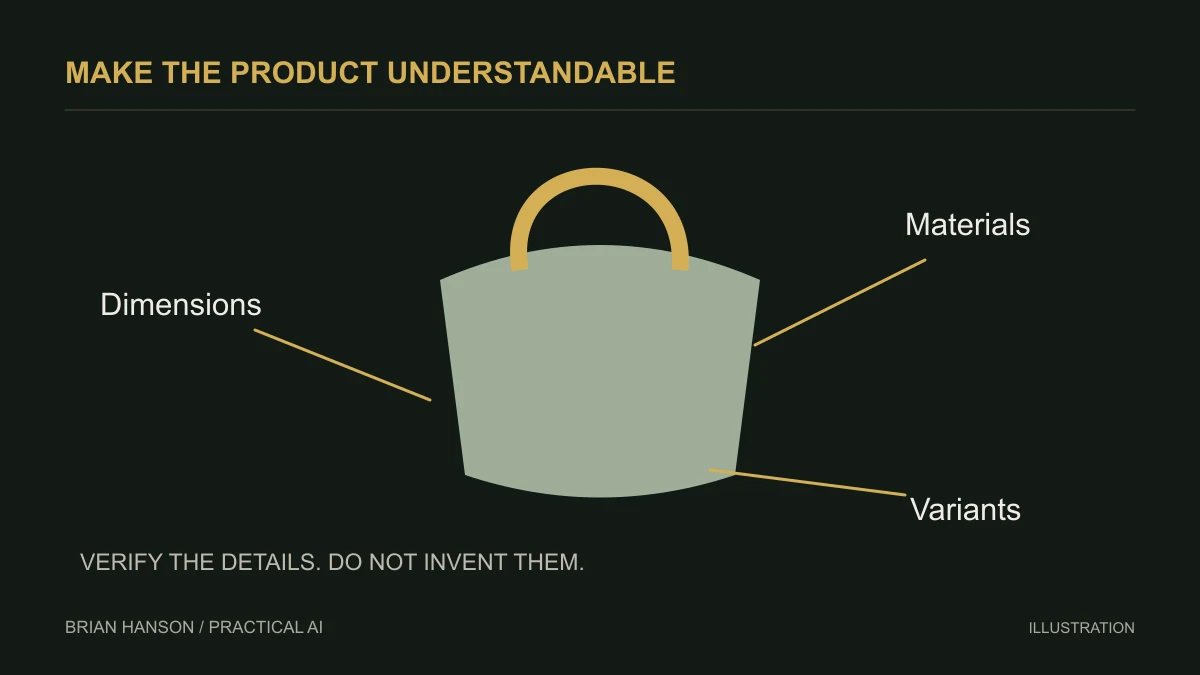
A shopper asks whether a bag fits a 15-inch laptop. Your product description says "perfect for everyday life." That is a writing problem and a data problem before it is an AI problem.
Start by making one product category easier to understand. Better catalog information is useful; it does not justify promising to double sales.
Give the product a clear identity
Shopify's product-details documentation explains that product information affects presentation, organization, and discovery. It also describes metafields for specialized details. Fill the fields that are relevant to the actual product, rather than filling everything with guesses.
| Check | Weak fictional entry | More useful direction |
|---|---|---|
| Title | Premium everyday bag | Identify the bag type and meaningful distinguishing feature |
| Fit | Fits all your essentials | State verified interior dimensions and any tested fit limitations |
| Variants | Blue / Navy / Dark blue used interchangeably | Use the actual variant names consistently |
| Availability | Description claims "always in stock" | Remove unsupported availability claims; check current inventory |
This table demonstrates review criteria, not a completed audit of your store. A plausible dimension generated by AI is still a made-up dimension.
Use AI to identify missing information
Review these product descriptions against the supplied specifications. List unanswered customer questions, contradictory statements, and inconsistent variant names. Quote the exact text causing each issue. Do not add dimensions, materials, certifications, compatibility, or performance claims unless present in the specifications. Return an edit checklist, not automatic changes.
Have someone who knows the product resolve the missing facts. Then update the source record so the corrected information is not trapped in one piece of marketing copy.
Test with the questions shoppers actually ask
Pick a few questions from real inquiries, remove private details, and try to answer them using the page alone. Ask another person to do the same. Record which answers are clear, absent, or contradictory.
After making changes, track relevant behavior over a stated period: product questions, search exits, add-to-cart actions, and purchases. Record other changes, including pricing and promotions. A small change in sales does not establish that the catalog edit caused it.
For the next operational step, read how to start a bounded Shopify workflow.