Why That Ugly AI Menu Is Your Marketing Warning Shot
Using AI without oversight leads to 'uncanny' marketing that kills customer trust. Recent examples of failed AI menu redesigns show that generic, glitchy images make brands look cheap. You must audit your AI assets for realism and ensure your digital presence matches your physical reality.
Key Takeaways
- AI brand consistency is about matching your digital marketing to your real-world service.
- Generic AI images with physical glitches like extra fingers or weird food signal a lack of quality control.
- Over-polished AI content often feels fake and drives away savvy customers.
- Use AI to enhance real photos of your business rather than generating fake scenes from scratch.
- Always edit AI-generated text to remove robotic phrases and maintain a human voice.
The Rise of the Uncanny Menu
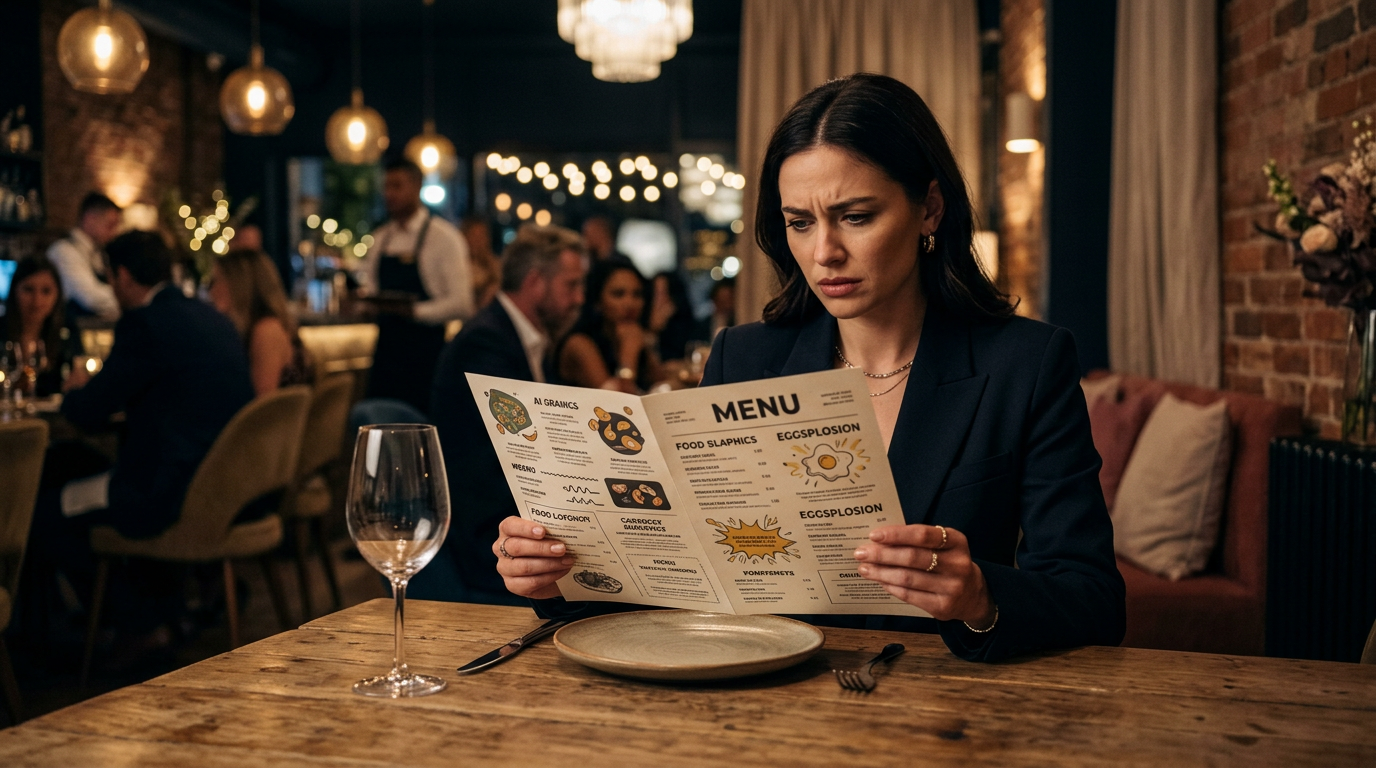
You might've seen the photos circulating online of local restaurants using AI to generate their menu photos. It started as a way to save a few hundred dollars on a photographer, but it ended with burgers that have 3 buns and pizzas topped with toppings that don't exist in nature. These businesses are falling into a trap I see small business owners walk into every week. They think AI is a magic wand that replaces quality control, but instead, it creates a generic mess that actually drives customers away. According to recent reports on businesses with ugly AI menu redesigns, the results are often more disturbing than appetizing.
The problem isn't the technology itself. The problem is failing to maintain AI brand consistency. When you post a photo of a steak that looks like it was grown in a lab or a staff photo where everyone has 6 fingers, you're telling your customers that you don't pay attention to details. If you don't care about the photo of the food, why should they trust you with the actual cooking? This uncanny valley (the term for when something looks almost human or real, but just off enough to be creepy) is a brand killer. It signals that your business is cheap, lazy, or fake.
The Cost of Being Generic
I want you to look at your current marketing through the lens of a skeptic. If you use ChatGPT to write your emails or Midjourney to create your social media posts, are you checking the output? Most business owners are so excited to save time that they bolt these tools onto their workflow without any oversight. They stack generic AI text on top of generic AI images. The result is a brand that has no soul and no connection to the local community. You end up looking like a franchise from a dystopian movie instead of the trusted local expert you actually are.
AI is meant to be your assistant, not your replacement. I think the biggest mistake you can make right now is letting the machine have the final word. You need to strip back the layers of automation and ensure your physical reality matches your digital presence. If your menu shows a triple decker burger but you only serve a single, you've lost that customer forever. The trust is gone before they even take a bite. You can see how bad it gets when you look at these failed AI menu redesigns where the food looks like plastic or alien geometry.
How to Audit Your AI Assets
You don't have to stop using AI. You just have to stop being lazy with it. I want you to start auditing every single piece of content that comes out of a generator. If it looks too perfect, it's probably wrong. Real life is messy. Real food has crumbs. Real offices have a little bit of clutter. When you use AI to create marketing materials, you should lean toward realism rather than the glossy, plastic look that comes by default. Here is how I'd handle this if I were in your shoes today.
1. Check the Anatomy and Physics
Look at the hands, the eyes, and the way shadows fall. If you're generating food, look at the textures. Does the cheese look like cheese or yellow wax? If there are people in the photo, do they look like they belong in your town? Most AI models default to a very specific, polished look that screams "I am a robot." If it looks like it belongs on a stock photo site from 2005, delete it and try again. You want to wire up your prompts to include words like "candid," "natural lighting," or "shot on an iPhone" to get away from that fake sheen.
2. Match the Reality of Your Service
If you're a plumber, don't use an AI image of a guy in a pristine white lab coat holding a golden wrench. It's ridiculous. Use tools to enhance a photo of your actual truck or your actual team. You can use AI to clean up the background or fix the lighting, but keep the core of the image real. The goal of AI brand consistency is to make sure the digital version of your business looks like the version I'd see if I walked through your front door. When the gap between the 2 gets too wide, you lose money.
3. Edit the Voice
This applies to your writing too. AI has a habit of using words like "tapestry" or "vibrant." Nobody talks like that in real life. When you get a draft back from an AI, sand down the edges. Remove the flowery adjectives. Make it sound like you're talking to a friend across a table. If you wouldn't say it out loud during a sales call, don't put it in your email blast. Your brand is your reputation, and a generic reputation is the same as having no reputation at all.
Your Action Plan for This Week
I don't want you to just read this and nod. I want you to take 30 minutes and look at your last 5 social media posts or your website's hero image. If you find something that looks like those unappetizing AI menus, pull it down. It is better to have no photo than a creepy one. Replace it with a real photo taken on your phone. Then, start a folder of "Real Brand Assets." These are photos of your actual office, your actual products, and your actual face. Use AI to edit these, not to invent them from scratch.
Next, I want you to join my 3 day training. We aren't going to talk about how to make weird alien burgers. We're going to talk about how to use these tools to actually grow your business without losing your identity. I'll show you how to set up the guardrails so your AI assistants stay on brand and don't turn your marketing into a laughingstock. You can learn how to do this the right way before you become the next viral example of what not to do.
Watch the feedback you get from your customers. If they start asking if your photos are real, you've already failed. The best AI is the kind that nobody notices. It should work in the background to make you faster and sharper, not to stand in front of you and look weird. Go check your website right now. If it looks generic, fix it.
FAQ
What is AI brand consistency?
It is the practice of ensuring all AI-generated content, including images and text, aligns with your company's actual values, visual style, and the reality of your products.
How can I tell if an AI image is 'uncanny'?
Look for physical impossibilities like extra limbs, distorted textures, or lighting that doesn't make sense. If it feels creepy or 'too perfect' to be real, it's likely in the uncanny valley.
Should I stop using AI for my business marketing?
No, but you should stop letting it run on autopilot. Use it as a starting point, then audit and edit the output to ensure it reflects your real business.