Why More AI Tools Won't Save Your Project Timeline
Brooks' Law applies to AI: adding more agents or staff to a late project makes it later by increasing the time spent on coordination and review.
Key Takeaways
- AI output does not scale linearly because of communication overhead.
- The bottleneck in AI workflows is the human review process, not the generation speed.
- Limit tasks to 2 agents or reviewers to avoid diminishing returns.
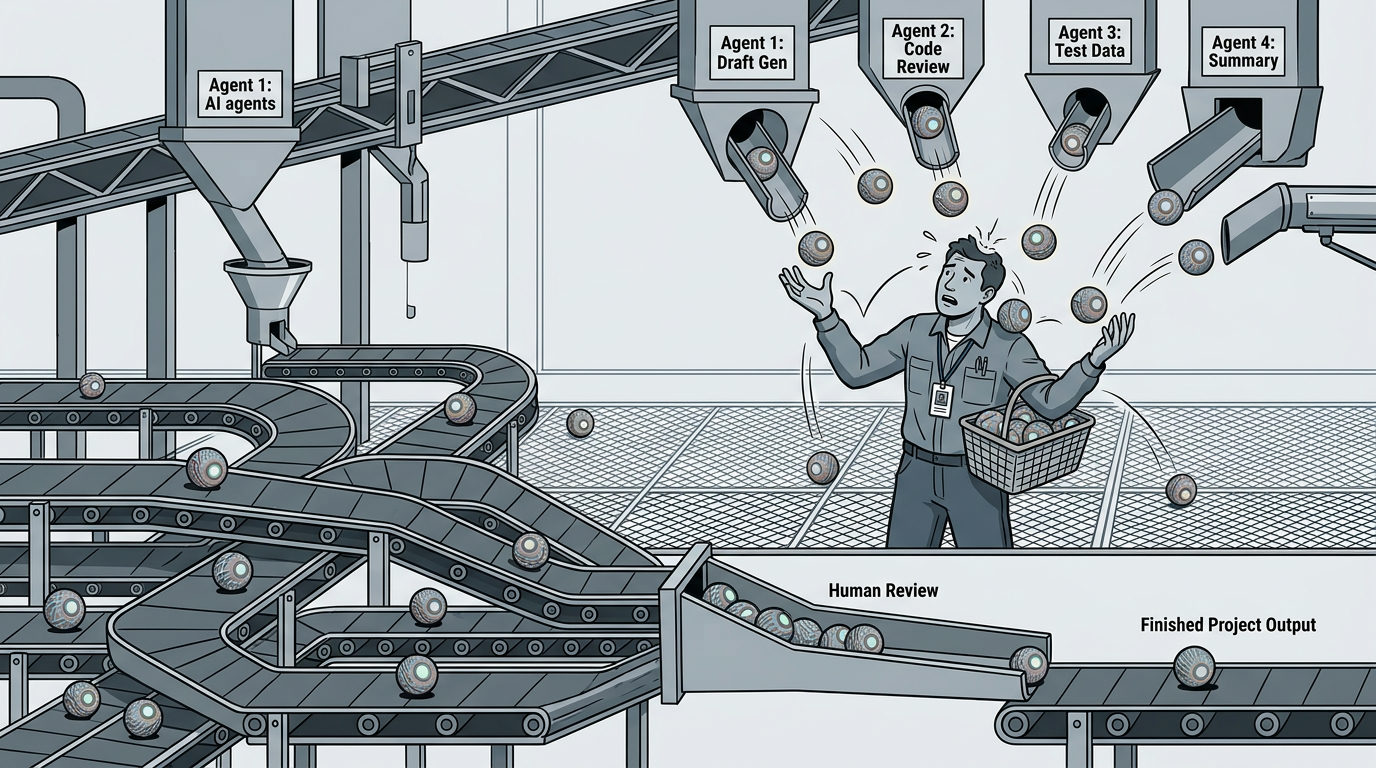
Adding more people to a late project makes it later. That is Brooks' Law, a rule from 1975 that still holds up. You might think hiring 3 virtual assistants or spinning up 10 AI agents (software programs that perform tasks automatically) will bypass this, but the math fails.
Output does not scale in a straight line with the number of tools or heads you add. If 1 person builds a landing page in 10 hours, 10 people cannot build it in 1 hour. Every new person or agent increases communication overhead. You'll spend more time explaining the task than the time you saved by getting help.
The Management Shift
When you use AI, the bottleneck moves from doing the work to reviewing it. Nine agents still cannot deliver a baby in 1 month. Sequential tasks, like writing a strategy and then executing it, must happen in order. If you stack too many AI tools on one project, they will eventually overwrite each other's work or hallucinate (make up facts) because the context gets messy.
The goal is to grow your team's capacity without increasing the noise. You have to shift from a "more hands" approach to a "better rails" approach. Someone still needs to define "done" and catch errors.
Check for Communication Debt
Before you add another tool or a new hire, count the handoffs. A handoff is every time information moves from one person or tool to another. Each handoff is a chance for a mistake. If your workflow looks like a spiderweb, adding AI only creates more errors at a higher speed.
- Limit the cooks: Keep 1 person responsible for the final output of 1 AI agent.
- Standardize the input: Use a single document for instructions so the AI does not have to guess.
- Define Done: If you cannot explain exactly what a finished task looks like, an AI will generate infinite drafts you have to read.
The 2-Agent Limit
Try to limit any single task to 2 AI agents or 2 human reviewers. Beyond that, you hit diminishing returns. The time you spend coordinating the different outputs will likely cost more than the value of the work itself. Keep your team lean. Focus on the quality of the instructions rather than the quantity of the workers.
To see how to wire up these workflows without the management headache, join our next training session.
FAQ
What is an AI agent?
An AI agent is a software program that uses an artificial intelligence model to perform specific tasks automatically, like researching a topic or writing code, based on your instructions.
Why does adding more AI slow things down?
Every new tool requires a human to review its work and coordinate it with other tools. This management work often takes longer than the time saved by the AI's speed.