Messy Spreadsheet? Check These Rows Before Asking AI for Answers
Use a fictional sales sheet to spot duplicates, inconsistent dates, and missing values before analysis. Includes a prompt and a reconciliation checklist.
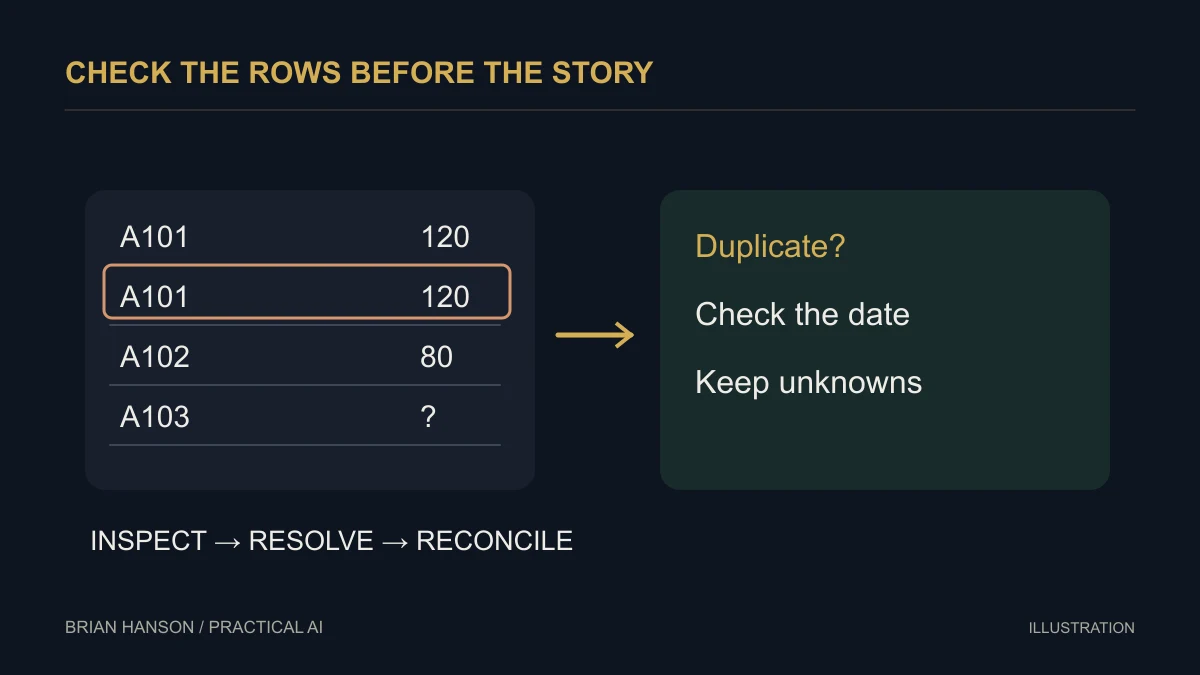
If the same order appears twice, AI can give you a beautifully written explanation of the wrong sales total. The first useful question is often: what is wrong with this file?
A model's performance on a puzzle does not establish that it can discover profit in your customer records. This walkthrough replaces that leap with a small, inspectable task: find data problems before calculating anything.
Start with a copy and one question
Keep your original unchanged. Use a small, de-identified sample with one row per record and clear headings. OpenAI's data-analysis guide recommends structured data and explains how to review the analysis. Check your organization's rules before uploading real records.
Find the problem in this fictional sheet
| Order | Date | Amount | Review |
|---|---|---|---|
| A101 | 2026-09-01 | 120 | Candidate valid record |
| A101 | 2026-09-01 | 120 | Possible duplicate; verify before removal |
| A102 | 09/02/2026 | 80 | Date convention needs confirmation |
| A103 | 2026-09-03 | Missing | Do not replace with an invented amount |
The two known unique order amounts total 200 if the repeated A101 is confirmed as a duplicate. That is not the complete period's sales: A103 is unresolved. A good answer should make that limitation hard to miss.
Ask for a problem report before a cleaned file
Inspect this fictional sales sheet. Identify possible duplicates, ambiguous dates, missing amounts, and inconsistent currencies. Preserve the original rows. Return a proposed change log with row references and reasons. Do not delete records, infer missing amounts, or calculate a complete sales total until I approve the rules. Separate confirmed observations from questions.
Then resolve the questions yourself. Is an order reference unique, or can an order legitimately have several line items? Are dates month-first or day-first? Are refunds negative sales or stored on another sheet? The model cannot establish your business definitions from column names alone.
Reconcile the result
- Count the original rows, retained rows, and excluded rows.
- Keep a reason for each exclusion.
- Compare known totals before and after the approved changes.
- Keep unresolved records in a separate review list.
- Spot-check several rows against the source system.
Once the file is trustworthy enough for the specific question, ask for the analysis. Clean data does not guarantee an accurate forecast or establish why customers behave a certain way. For a bounded first project, use the small-business AI guide.