Did Your Pop-Up Pay Off? Work Through These Numbers
Use an illustrative worksheet to separate event revenue, product costs, and event costs. Track later sales without pretending attribution is perfect.
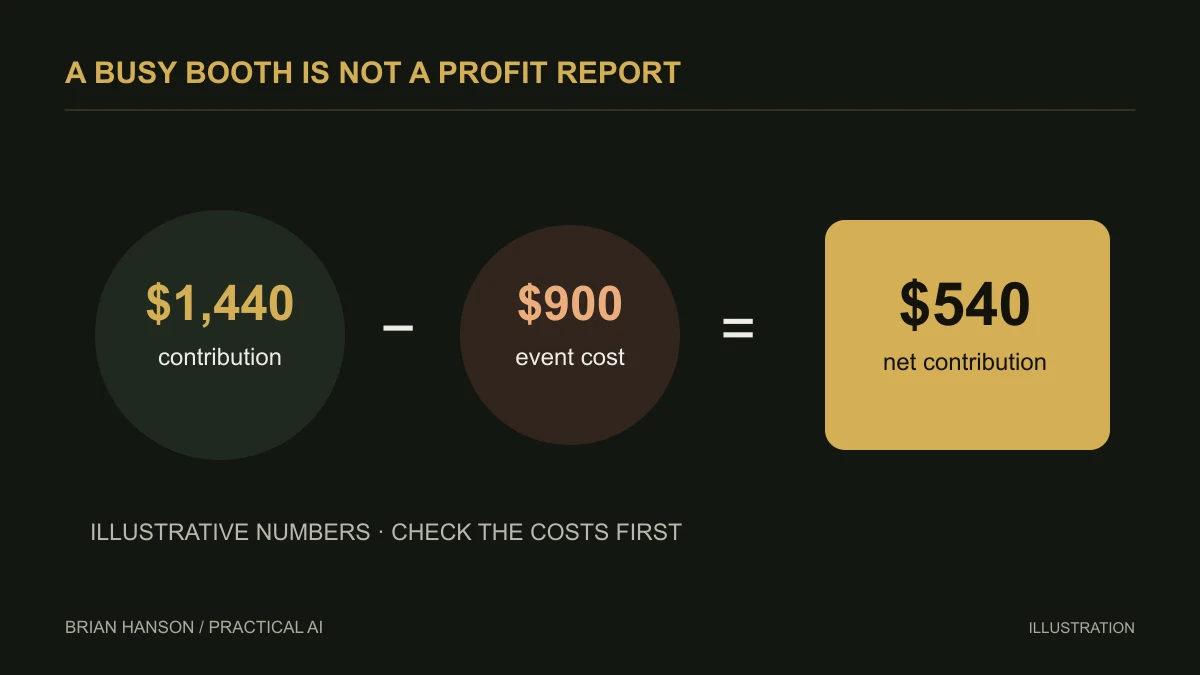
A busy booth can lose money. A quiet booth can produce a customer who buys again. Count both the immediate result and later follow-up, but keep the numbers separate.
For this worksheet, event ROI means net event contribution divided by event cost. Define the terms before comparing events. This is a planning example, not accounting advice or a report of actual results.
A worked example with fictional numbers
| Item | Example amount | What it includes |
|---|---|---|
| Attributed sales | $2,400 | Sales linked to the event within your chosen window |
| Product and transaction costs | $960 | Costs directly associated with those sales |
| Contribution before event costs | $1,440 | $2,400 minus $960 |
| Event costs | $900 | Booth, travel, materials, and budgeted staffing |
| Net event contribution | $540 | $1,440 minus $900 |
| Event ROI under this definition | 60% | $540 divided by $900 |
Choose whether and how to allocate owner time and shared overhead, and document that choice. Include refunds and discounts. Comparing one event that includes staffing with another that excludes it will produce a misleading ranking.
Build the worksheet before the event
Make columns for event name, date, order reference, sales amount, direct cost, attribution method, and refund amount. Keep an event-cost sheet beside it. Choose a follow-up window in advance, such as 30 days; that is a measurement choice, not a universal standard.
A checkout note, event-specific link, or customer answer can help associate a sale with the event. Keep uncertain sales in an unconfirmed category. An association does not prove the event caused the purchase, and the same sale should not be counted twice.
Where AI can help
ChatGPT's data-analysis documentation describes working with uploaded spreadsheets and reviewing the analysis. Use a de-identified copy and ask for transparent calculations, not an impressive-looking summary.
Using these two example sheets, calculate contribution by event. Show the formula and rows used. Separate confirmed and uncertain attribution. Flag missing costs, refunds, duplicate order references, and events with zero event cost. Do not invent missing values or divide by zero. Return a table I can reconcile against the source.
Check the answer before booking again
Recalculate one event manually. Reconcile total sales with your records. Compare the event against another way you could spend the same time and budget. Keep qualitative notes, such as audience fit, alongside the figures without quietly assigning them invented dollar values.
For a useful follow-up process after the event, see the AI sales and customer service guide.