Stop Chasing Amazon Delivery Speed and Use AI to Predict Your Inventory Instead
Stop trying to out-ship Amazon. Use AI to predict inventory demand and manage cash flow. By connecting predictive tools to your store, you can automate reorders, reduce dead stock, and free up capital for growth.
Key Takeaways
- Predictive inventory beats shipping speed for small business profitability.
- AI tools identify sales patterns that human spreadsheets miss.
- Inventory tied up in warehouses is wasted capital that could be used for marketing.
- Small businesses use AI-assisted sales tools like Bero to compete with enterprise logistics.
- Clean data on lead times is the foundation for successful AI implementation.
The Losing Battle of Faster Shipping
You can't out-ship Amazon. They've spent billions building a logistics web that puts products in customers' hands within hours. If you try to compete on speed alone, you'll bleed cash on expedited freight and warehouse fees. The real win for small businesses isn't moving faster after the order is placed: it's knowing what the customer wants before they even click buy.
MarketScale reports that AI and same-day delivery are the two forcing functions reshaping how products move across the U.S. While the big players focus on the delivery side, smart founders use AI ecommerce operations for small business to fix the inventory side. Brands like Bero use AI-assisted sales tools to sharpen their B2B operations. They aren't just reacting to orders. They're positioning stock where it needs to be based on data.
The Predictability Pivot
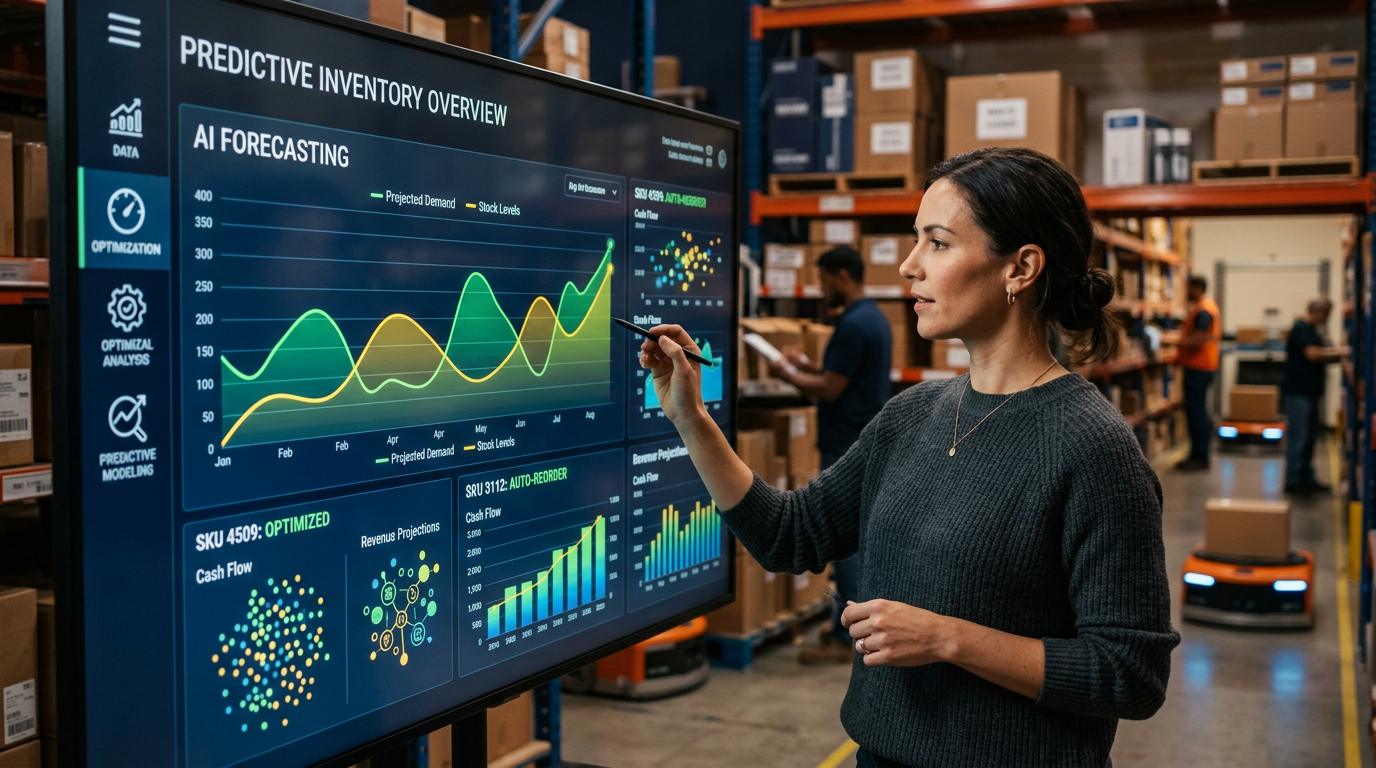
Most small business owners treat inventory like a guessing game. You look at what you sold last year, add a little extra for growth, and hope you don't end up with a garage full of dead stock. This ties up your capital. When your money sits on a shelf as unsold products, you can't spend it on ads or new hires.
AI changes this by looking at patterns you'd never spot in a spreadsheet. It factors in seasonality, local weather trends, and even social media spikes. Instead of a flat forecast, you get a moving target that tells you exactly when to reorder. You stop paying for storage on items that won't move for 6 months. You use that saved cash to grow the business elsewhere.
The Efficiency Edge
I've seen too many owners get distracted by same-day shipping. They drive themselves crazy trying to shave 4 hours off a delivery time. Meanwhile, their back-office operations are a mess of manual data entry and missed reorder points. If you want to scale, you have to strip back the manual labor and bolt on systems that think for you. Predictive inventory (software that guesses future sales based on past data) isn't just for the giants anymore. The tools available today let a solo founder run a supply chain that looks like it has a 20-person team behind it.
How to Stack Your Operational Tech
You don't need a degree in data science to start. You just need to connect your existing store data to tools that can read it. Here are 4 steps to wire up your inventory prediction this week.
1. Audit your lead times. Most people guess how long it takes for a product to arrive from the factory. Look at your last 5 shipments and get the real average. AI needs clean, honest numbers to give you a good result. If you tell the system it takes 14 days but it actually takes 21, the machine will fail you.
2. Connect a demand planning tool. If you use Shopify or BigCommerce, look for apps that offer predictive analytics. These are small programs that plug into your store and scan your history. They identify which products are your hero items and which ones are just taking up space. This is the first step in AI ecommerce operations for small business.
3. Set up automated low-stock triggers. Don't wait until you see a 0 on your screen. Use your AI tool to set a safety stock level. The system calculates how much you sell per day and alerts you when you have just enough left to cover the time it takes for a new shipment to arrive. This prevents stockouts, which are the fastest way to lose a customer to a competitor.
4. Analyze your returns data. AI is great at spotting why people send stuff back. If a specific item has a high return rate, the AI can flag it before you buy another 500 units. Maybe the sizing is off or the photos are misleading. Fixing this saves you more money than faster shipping ever could.
The New Standard for Small Business
The goal is to reach a point where your operations are boring. You want a system that quietly manages the flow of goods so you can focus on strategy. The technology is here to make that happen without a massive price tag. You don't have to be a tech genius to start using these tools. You just have to be willing to stop doing things the manual way.
Watch your inventory turnover ratio (how many times you sell through your stock in a year) over the next 90 days. If you're using AI correctly, that number should go up. You'll be selling through your stock faster because you're only buying what the market actually wants. That's how you beat the big guys: not by being faster at the door, but by being smarter in the warehouse.
If you want to see exactly how to wire these tools into your business, join the free 3-day training. We will set up these systems step by step so you can stop guessing and start growing.
FAQ
Do I need to be a programmer to use AI in my store?
No. Most predictive inventory tools are simple apps you can plug directly into platforms like Shopify or BigCommerce with a few clicks.
Is AI inventory management expensive?
Many tools offer tiered pricing based on your order volume, making it affordable for small businesses to start for a low monthly fee.
How much data do I need for AI to work?
Ideally, you should have at least 6 months of sales history so the AI can identify seasonal trends and customer behavior patterns.