Give Claude a Sales Brief Before Giving It More Access
Define a bounded sales task, supply approved evidence, and review the output before sending anything. Includes a reusable brief.
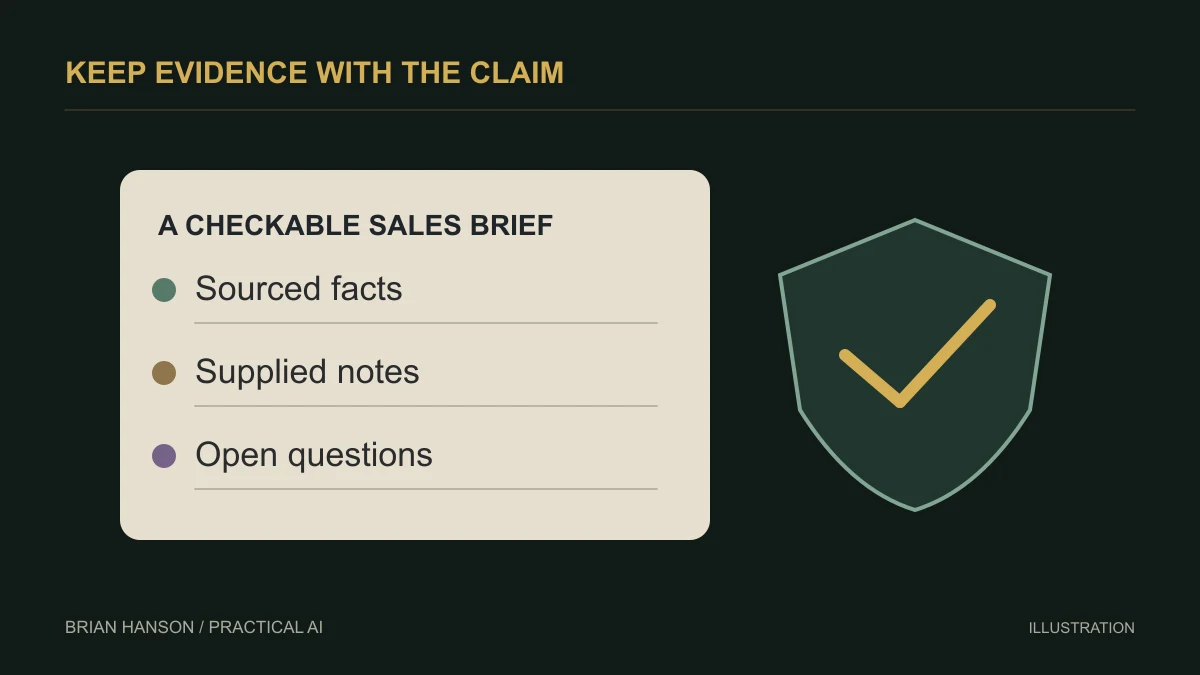
Ask for a brief your salesperson can check before asking an assistant to act on an account. A useful first result is a document with evidence and unanswered questions.
Choose the task before the workflow count
Anthropic’s introduction to Claude for Small Business describes ready-to-run workflows and connectors for business tools. The launch announcement lists 15 workflows and emphasizes approval before sending, posting, or paying. Catalogs can change, so inspect the current options in your account instead of planning around an unverified headline count.
This revision removes the earlier unsupported claims about 43 new sales workflows, 27 new integrations, and installation totals.
Start with a reviewable deliverable
A meeting brief is a manageable starting point: approved account facts, open questions, and a proposed agenda. Define exactly which records may be used. Connect only the required tools, and confirm the account and workspace before granting access. Avoid making the first task an unattended outreach campaign.
Example: “Prepare a draft meeting brief from these approved records. Cite the record behind each factual statement. Separate open questions from known facts. Do not contact anyone or update the CRM.”
Review facts and permissions separately
Check whether each source supports the statement, whether the information is current, and whether the proposed next step is appropriate for this customer. Then review the action itself: recipient, destination record, attachments, and timing. A well-written message can still go to the wrong contact.
Keep the approved output and note any correction that would help the next run. Repeated missing information usually calls for a better source or narrower scope, not a more elaborate prompt.
Expand only after a useful trial
Compare preparation time and correction effort across a small number of ordinary tasks. Include the time spent connecting systems and reviewing drafts. Before adding scheduling or writes, establish who owns failures and how an incorrect change can be reversed. Check current plan availability and connector requirements in Anthropic’s product documentation.
The goal is a reliable, repeatable task that your team understands. A larger catalog does not by itself mean more value for your business.
A brief for a fictional prospect
Prepare a sales research brief from the approved sources below. Separate sourced facts, my supplied notes, and hypotheses to discuss. For every company claim, include its exact source and date if available. Leave unknown budget, buying authority, and timing as questions. Suggest three discovery questions. Do not send messages, update records, or claim a relationship we have not established.
Compare the draft with the evidence
Open each source. Check that it supports the adjacent claim about the same company and time period. Remove personalization that depends on an assumption about the person. Give the salesperson the unresolved questions alongside the brief so uncertainty does not disappear during the handoff.
This example is a proposed workflow, not a report of using Claude on a real prospect or a promise of higher close rates.
Continue with the AI sales and customer service guide for a broader implementation plan.