If AI Can Win a Dogfight, It Can Manage Your Project Schedule
A DARPA test proved AI can handle high-stakes aerial dogfights. For business owners, this validates using AI for complex decision making, like automated scheduling and project management, to save time and reduce human error.
Key Takeaways
- AI has moved beyond simple text and can now handle split-second physical maneuvers.
- Machine learning uses historical data to predict and avoid future bottlenecks.
- Business autopilots like AI calendars manage complex dependencies better than manual entry.
- Success requires clean data and clear guardrails, similar to military flight tests.
- Simulating project failures with AI helps identify risks before they cost money.
Trusting the Machine with High-Stakes Operations
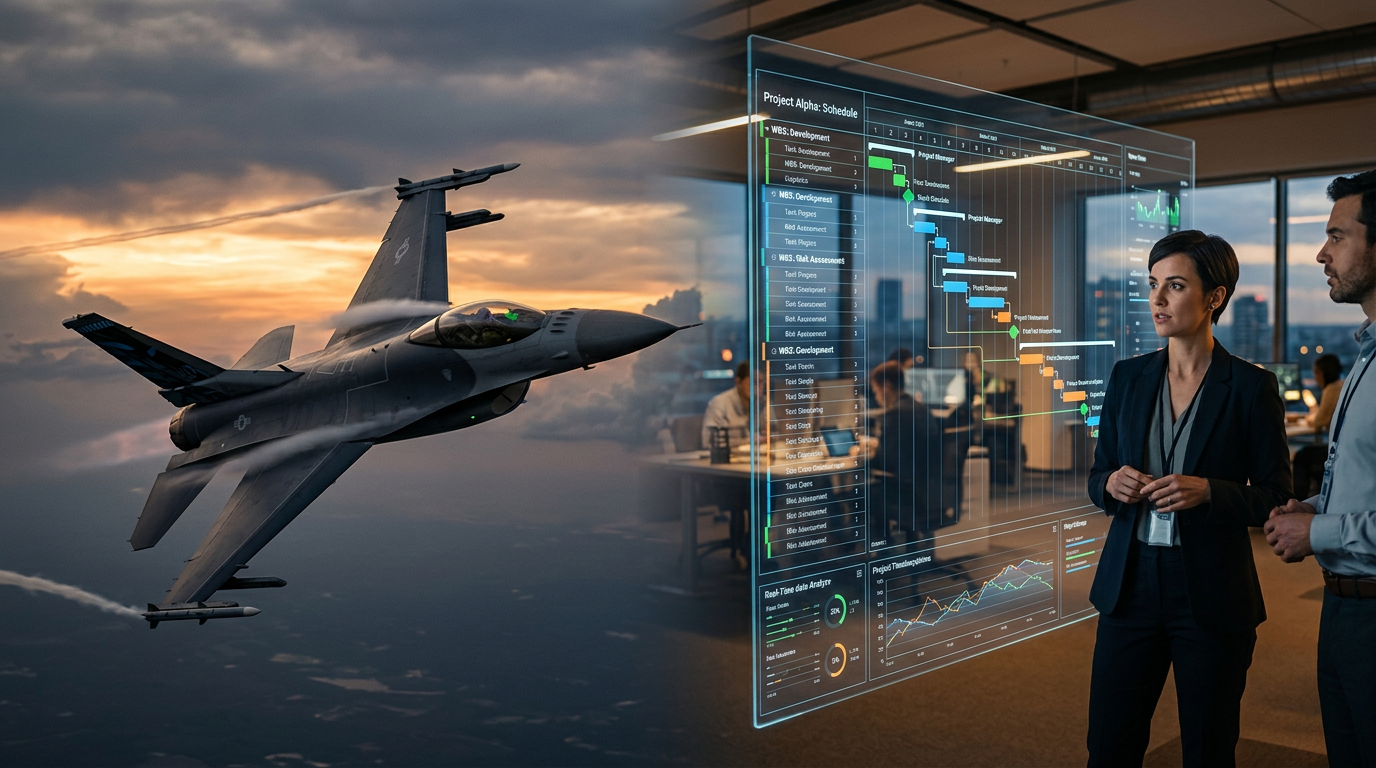
The U.S. Air Force recently flew an AI-controlled F-16 fighter jet in a dogfight against a human pilot. According to DARPA, this test used machine learning (software that improves through experience) to handle split-second decisions at supersonic speeds. If a computer can manage the physics of aerial combat, it can handle your project logistics. It's time to rethink AI decision making for business.
Most business owners use AI as a better search engine. They ask it to write an email or summarize a meeting. That's fine, but it skips the real power. The military uses AI to process thousands of data points faster than a human can blink. In your office, those data points are project deadlines, staff availability, and supply chain delays. You shouldn't manually move blocks on a calendar when a machine can calculate the ripple effect of a delay in seconds.
I see hesitation when it comes to letting software make choices. We worry about losing control. But the DARPA test proved that AI can operate within strict safety boundaries while outperforming traditional logic. You can bolt on an AI layer to your project management that suggests the best path forward when things go wrong. It's a digital co-pilot for your operations.
The Mechanism of Machine Reliability
The F-16 didn't crash because of reinforcement learning. Think of it like training a dog with treats, but at the speed of light. The AI tried millions of maneuvers in a simulation. When it succeeded, it got a digital reward. By the time it got into the cockpit of the X-62A (the modified F-16 used for the test), it had more flight hours than any human pilot.
You can apply this logic to your workflows. When you feed historical project data into an AI tool, it sees patterns you'd miss. It might notice a specific vendor is late every time it rains in Ohio. AI decision making for business isn't about replacing your intuition. It's about removing the guesswork from logistics so you can focus on strategy.
The biggest hurdle is the data we provide. If your current schedule is a mess of sticky notes and unorganized emails, no AI can save you. You have to strip back the chaos and put your processes into a structured format first. Once the data is clean, the AI can start making those high-stakes calls for you.
How to Wire Up Your Business Autopilot
You don't need a Pentagon budget to start. You just need to change how you interact with your software. Here are four ways to start stacking these wins this week.
First, audit your current scheduling. Look for where three or more people's schedules collide with a hard deadline. Instead of solving the puzzle yourself, use a tool like Reclaim or Motion. These are AI-driven calendars that automatically reshuffle tasks based on priority. They function like an autopilot for your time, moving low-priority work when a high-stakes meeting pops up.
Second, stop manually updating project dependencies. A dependency is just a relationship where Step B can't happen until Step A is done. In tools like Asana or Monday.com, you can set up automations that act as tiny AI agents. If a shipment is delayed, the AI can notify the client and push the installation date back without you touching a keyboard.
Third, use AI to run simulations. Take your project plan and ask a tool like Claude or ChatGPT to find the weak points. Tell it: "Here is my 30-day plan. Identify the three most likely places where a single delay will cause the whole project to fail." It will find the bottlenecks faster than you can find your reading glasses.
Finally, set your guardrails. The F-16 test worked because human pilots could take over at any time. You should do the same. Start by letting AI handle non-critical scheduling. As it proves it can handle the load, give it more authority. You aren't handing over the keys; you're hiring a fast assistant who never sleeps.
What to Watch Next
Keep an eye on Agentic AI. This is where AI doesn't just give an answer, but actually performs the task. We're moving toward systems that can log into your software, move data, and send confirmations. The military showed that trust is earned through testing. Pick one complex, recurring task and let a machine try to solve it. If it can handle a dogfight, it can handle your Monday morning.
FAQ
What is AI decision making for business?
It is the use of machine learning algorithms to analyze data and choose the best course of action for tasks like scheduling, inventory management, or project workflows.
Is AI reliable enough for my business operations?
Yes, when given clear data and boundaries. Recent military tests show AI can perform safely in high-pressure environments like fighter jet combat.
What is a project dependency?
A dependency is a relationship between tasks where one job must be finished before the next one can start. AI helps manage these by automatically updating the whole schedule when one task shifts.