How to Spot Buying Trends Before Your Competitors Using AI Market Sensing
Stop guessing what customers want. Use AI to synthesize reviews, social media, and search data into clear buying trends. This market sensing lets small businesses pivot faster than big brands by spotting shifts in consumer behavior weeks before they become obvious.
Key Takeaways
- Market sensing uses AI to filter noise and find actionable buying signals.
- Small businesses can pivot faster than corporations by using AI for rapid data synthesis.
- Start by feeding AI raw text from reviews, Reddit, and YouTube comments.
- Look for shifts in customer sentiment, such as a move from price-focus to quality-focus.
- Test AI-spotted trends with small, low-cost experiments before committing fully.
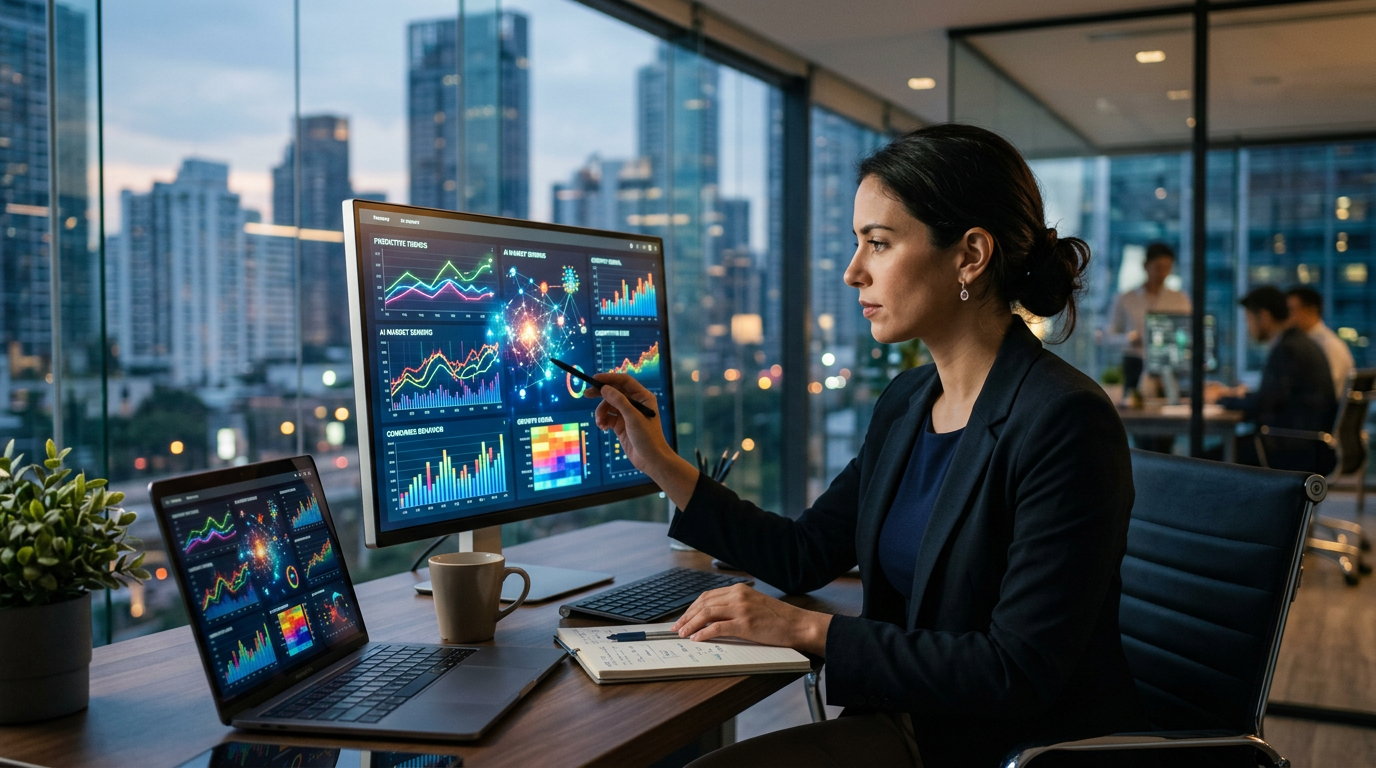
Stop Guessing and Start Sensing
Most small business owners rely on gut feelings or last month's sales reports to decide what to stock. That's like driving a car by looking in the rearview mirror. You see where you've been, but you've no clue what's coming around the bend. According to Forbes research, top companies use AI for rapid market sensing to catch shifts in consumer behavior before they become obvious.
Market sensing is just listening to the market in real time. It's the process of collecting data from social media, reviews, and search trends to figure out what people want right now. Large corporations spend millions on teams to do this. You can do the same thing with a $20 monthly AI subscription and a few smart prompts. You don't need a data science degree to wire this up to your business.
The Mechanism of AI Market Sensing
AI market sensing works by taking thousands of data points that would take a human weeks to read and turning them into a simple summary. Think of it as a giant filter. You pour in the noise of the internet, and the AI hands you the signal. This allows you to spot a trend in a specific niche, like a sudden interest in specific home office gear, weeks before your competitors notice the shift.
Many founders get overwhelmed by the volume of information available. They try to read every comment and check every competitor's website manually. That's a recipe for burnout. The goal is synthesis. You want the AI to look at the mess and tell you the 3 things that actually matter for your bottom line. It's about execution efficiency, not just having more data.
Practitioners save dozens of hours a week by letting AI handle the heavy lifting of data analysis. Instead of staring at spreadsheets, they spend that time talking to the customers the AI identified as high value. You're stripping back the busy work so you can focus on the work that brings in cash.
Step 1: Feed the Machine the Right Data
The first step to AI market sensing for small business is gathering your inputs. You don't need a complex software stack. Start by exporting your customer reviews from the last 6 months. Grab the text from the top 10 most popular videos in your niche on YouTube or the top threads on Reddit where your customers hang out. Copy and paste this text into a document.
You're looking for raw, unfiltered human language. AI is incredibly good at spotting patterns in how people talk. If 50 people mention the same frustration with a competitor's product, but they use different words to describe it, the AI will still catch the connection. This is the synthesis of complex data that industry experts call the new rule of marketing.
Step 2: Ask the AI for Patterns, Not Answers
Once you have your data, you need to prompt the AI correctly. Don't just ask "what should I sell?" That's a weak question that gets a weak answer. Instead, tell the AI to look for 3 specific things: recurring complaints, unmet desires, and shifts in tone. Ask it to compare the sentiment of reviews from 6 months ago to the reviews from last week.
If you notice that customers are suddenly asking about the durability of a product when they used to only care about the price, that's a trend. You can pivot your marketing to highlight how long your product lasts. This puts you ahead of the curve. You're answering the question the customer is just starting to ask, rather than repeating the same old sales pitch.
Step 3: Test the Trend with a Small Batch
Market sensing gives you the lead, but you still need to verify it. Take the insight the AI gave you and run a small test. This could be a single email to your list or a $50 ad campaign focused on that specific new trend. If the engagement is higher than usual, you've found a winner. If not, you only lost a few dollars and an hour of work.
This is where small businesses have a massive advantage over big brands. A big company has to get 3 layers of management to approve a new marketing angle. You can spot a trend on Tuesday and have a new offer live by Thursday. That speed is your greatest weapon. AI just gives you the map so you know which way to run.
Step 4: Automate the Pulse Check
You shouldn't do this just once. Set a recurring task on your calendar to run this process every month. As you get faster at it, you can start looking at broader data sets. You might look at Google Trends data for your industry or news headlines from trade publications. The more diverse your inputs, the sharper your sensing becomes.
I recommend setting up a simple folder where you drop screenshots of customer emails or interesting social media posts throughout the month. When it's time for your sensing session, you have all your raw material ready to go. It turns a chore into a 20 minute routine that keeps your business relevant.
What to Watch Next
The next shift in this space is real-time integration. We're moving toward tools that can listen to your customer service calls or read your chat logs as they happen and alert you to a trend the moment it starts. For now, focus on the manual process of gathering and synthesizing. It builds the muscle you need to understand what the data is actually telling you. If you want to see how we wire these systems up live, the free 3-day training covers the exact prompts and tools used to make this happen without a tech team.
FAQ
What is AI market sensing?
It is the process of using artificial intelligence to analyze large amounts of data like social media posts and reviews to identify new trends and customer needs in real time.
Do I need special software for this?
No, you can start by using a standard AI tool like ChatGPT or Claude by copying and pasting data from your market into the chat.
How is this different from regular market research?
Traditional research is often slow and looks at past behavior. AI market sensing is rapid and focuses on identifying shifts as they are happening.