Why Your Local Data Center Might Be Raising Your Storefront's Cooling Bill
Research shows data centers act as radiators, raising local temperatures and forcing nearby businesses to pay higher AC bills. Owners should measure intake temperatures and use reflective roof coatings to offset this hidden overhead.
Key Takeaways
- Data centers exhaust waste heat that creates local hot spots in urban areas.
- Small businesses near these facilities face higher electricity bills from increased AC demand.
- Localized heat leads to premature failure of expensive HVAC equipment.
- Measuring the temperature at your AC intake vs. official reports reveals your actual heat exposure.
- Physical buffers like trees and reflective roof coatings help fight local temperature spikes.
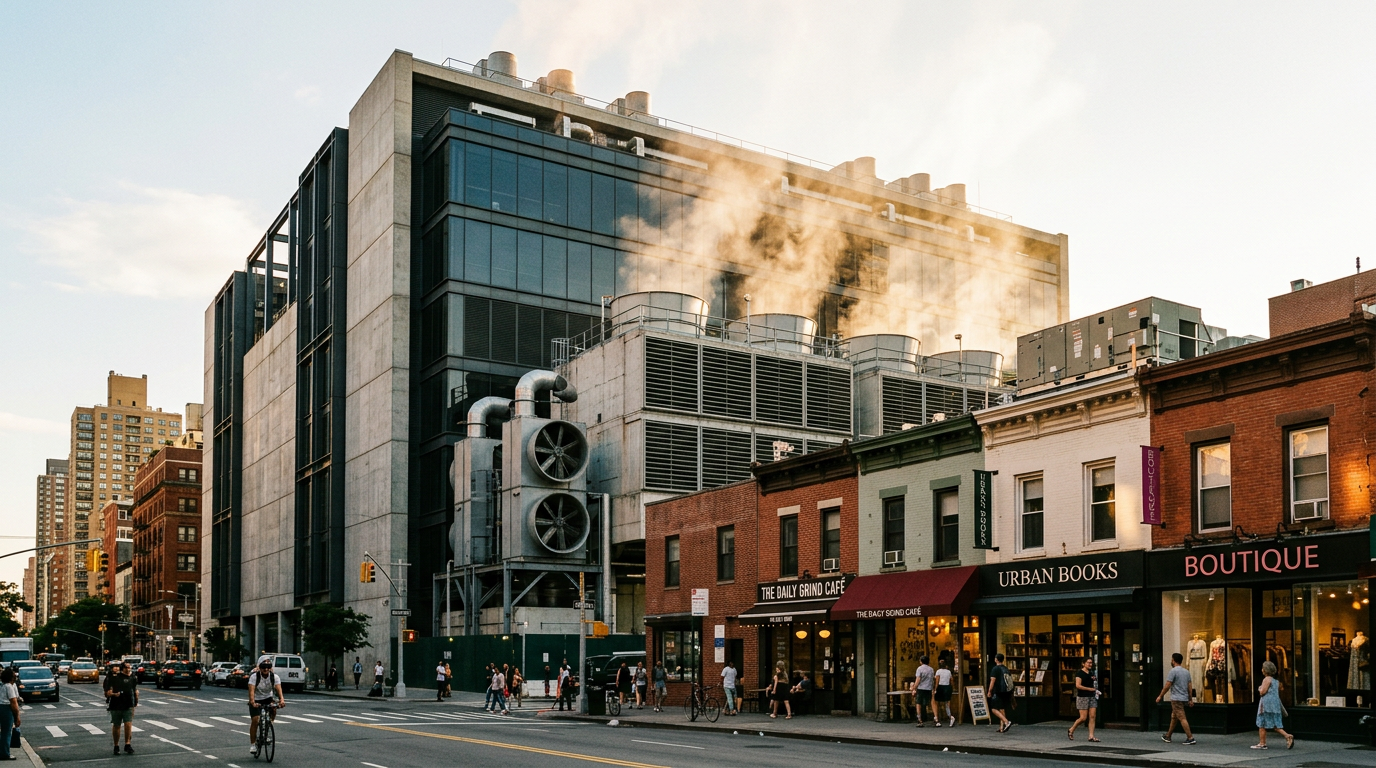
The Hidden Cost of Your New Digital Neighbors
If you run a shop or an office in a city, you probably think the massive data center down the street is a quiet neighbor. You don't see traffic or hear noise, so you assume it has zero impact on your overhead. New research from the ASME Journal of Sustainable Buildings and Technology shows these buildings are actually giant radiators. They pump out enough waste heat to physically change the temperature of your neighborhood. This isn't a theory: it's a line item on your utility bill.
Data centers are the engine rooms of the internet. They house thousands of computers that run email and AI tools. These machines get hot, so the buildings use massive fans to pull that heat out and push it outside. The study found this exhaust creates concentrated hot spots. When the air outside your front door is hotter, your air conditioning (AC) unit works harder to keep customers cool. You're paying to offset the heat generated by a billion-dollar tech company.
The Physics of the Urban Heat Island
Most cities suffer from the urban heat island effect. This happens when concrete and asphalt soak up sun during the day and radiate it back at night. Data centers stack on top of this. They generate their own heat 24 hours a day, 7 days a week. If your storefront is downwind from one of these plants, you're standing in the exhaust path of a giant hair dryer.
Check your electricity bill. Most owners look at the rate per kilowatt-hour (the unit of energy you use), but they don't look at why the volume is creeping up. If your local air is 2 or 3 degrees warmer because of a nearby server farm, your AC compressor cycles more often. That wear and tear means you'll be replacing that $10,000 rooftop unit years earlier than planned. It's a hidden tax on physical businesses.
I've seen buildings where the air pulled into the HVAC (heating, ventilation, and air conditioning) system is significantly hotter than the weather report claims. This is a change in your local environment. You have to treat the air outside your building as a variable you no longer fully control.
How to Protect Your Bottom Line
You can't move the data center, but you can change how your building reacts. Stop guessing and start measuring. Buy a simple outdoor thermometer and mount it near your AC intake. Compare that reading to the official weather report. If your intake air is consistently 5 degrees hotter than the airport reading, you have a localized heat problem.
Look at your roof. If it's dark, you're soaking up even more heat. A white "cool roof" coating reflects up to 80% of sunlight. This lowers your internal cooling needs even when the air outside is hot. Next, look at your landscaping. Planting tall, leafy trees between your building and the data center acts as a physical buffer. It breaks up the heat plumes before they hit your walls.
3 Steps to Take This Week
- Check utility bills from the last 3 years. Look for usage spikes in May and September.
- Locate the nearest server farm on a map. See if you're within a one-mile radius.
- Schedule a professional coil cleaning for your AC. Hotter air carries more dust from industrial fans, which clogs your system and kills efficiency.
What to Watch Next
Cities are starting to realize these buildings can't dump heat without consequence. Expect new zoning laws that require data centers to pay heat impact fees. Until then, the cost is on you. If a new data center is proposed for your block, show up to the planning meeting and ask about their thermal exhaust plan. Protecting your margins starts with the air around your shop. If you want to see how to audit your costs against these shifts, I'll walk through the math in our next live session.
FAQ
How far does the heat from a data center travel?
While the most intense heat is at the exhaust point, studies show impacts at a neighborhood scale, potentially affecting buildings within a one-mile radius.
Will my utility company give me a credit for this extra heat?
No. Utility companies bill based on your usage. Individual mitigation is your only defense.
Does this only happen in the summer?
No. Data centers run 24/7. This extra heat can prevent your building from cooling down naturally at night during the spring and fall.