Oracle’s Data Center Delay: How to Build a Fail-Safe for Your AI Automations
If your primary cloud provider fails, your AI automations stop. Mitigate this risk by using a multi-cloud strategy: set up backup workflows on a different provider and keep independent copies of your data.
Key Takeaways
- The cloud is physical infrastructure subject to legal, regulatory, and environmental failures.
- Oracle's use of 'force majeure' highlights that even giant providers face infrastructure delays.
- Multi-cloud redundancy involves having a secondary AI model ready to take over if the primary one fails.
- Never store your only copy of critical data inside an AI provider's ecosystem.
The cloud sounds like an invisible force. It's actually just a massive building filled with humming servers, miles of copper wire, and heavy cooling fans. If that building hits a snag, your business tools stop working instantly.
Oracle recently sent a notice citing "force majeure" regarding its Project Jupiter data center in New Mexico, according to Bloomberg. Force majeure is a legal term for unforeseeable circumstances, like an act of God, that let a company pause its contracts. Oracle's using this to delay payments because the project, originally set for 2028, faces regulatory setbacks and local opposition.
For a giant like Oracle, this is a legal maneuver to save money. For you, it's a reminder that the AI tools you use every day rely on physical real estate that can fail, get delayed, or lose power. If your primary provider goes dark, your automated customer service, lead generation, and data processing go dark too.
The Multi-Cloud Redundancy Plan
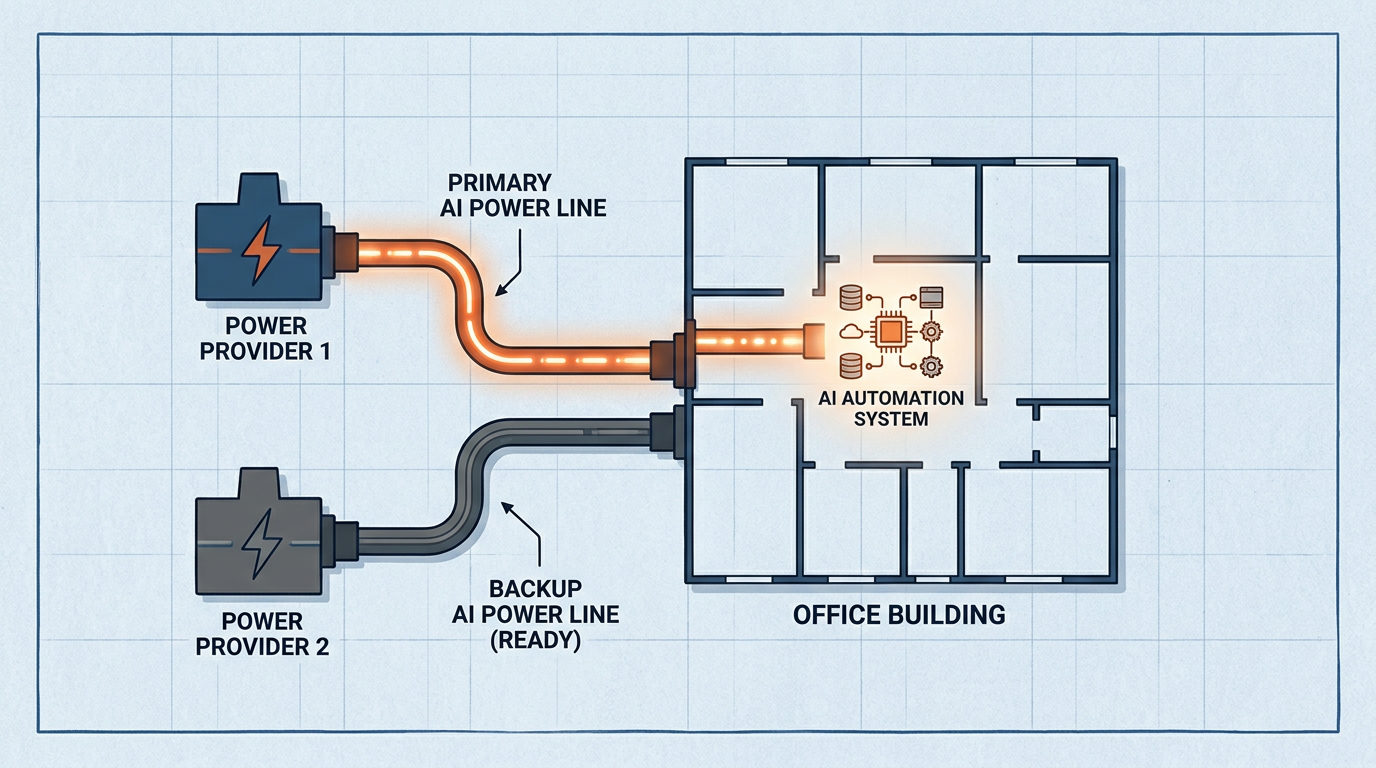
Redundancy is just a backup plan. You shouldn't rely on a single server in a single building. You can protect your operations by spreading your tools across different providers. This is a multi-cloud strategy.
First, audit where your AI actually lives. Most business owners use a mix of three main providers: Microsoft (Azure), Google (Google Cloud), and Amazon (AWS). If you use ChatGPT, you're likely tied to Microsoft’s infrastructure. If you use Gemini, you're on Google’s.
Second, wire up a second provider for your most critical tasks. If you use an automation platform like Make or Zapier to send data to an AI model, don't just connect to one model. Set up a duplicate workflow that uses a different provider. For example, if your main process uses Claude (Anthropic), have a backup version ready that uses GPT-4 (OpenAI). If one service reports an outage, you can flip a switch and keep the business running.
Secure Your Data Outside the AI
The biggest risk isn't just the AI stopping: it's losing the data that feeds it. Don't store your primary business records inside a single AI tool's chat history or a single provider’s database. Keep a clean copy of your data in a neutral location, like a simple spreadsheet or a local hard drive backup.
Think of it like having two different power generators for your house. If the city grid fails, you have a backup. If the backup fails, you still have the fuel stored in the garage. In this case, the fuel is your data.
Start by identifying your most important automation. Ask yourself: if this stopped working for 48 hours, how much money would I lose? If the answer is more than $0, it's time to stack a second provider into your workflow today.
FAQ
What is a multi-cloud strategy?
It means using more than one cloud provider (like Microsoft and Google) so your business stays online if one company has a server failure.