How to Turn Your Offshore Staff into AI Operators
The Philippines labor market is facing massive shifts due to AI. Instead of hiring new experts, retrain your existing remote staff to use AI tools for repetitive tasks, moving them from doers to editors to increase efficiency and retain talent.
Key Takeaways
- AI retraining for remote teams is urgent as the Philippine labor market undergoes major changes.
- Transition staff from manual execution to Editor roles where they manage AI output.
- Build a shared library of prompts to keep institutional knowledge within your company.
- Focus on one repetitive bottleneck at a time to avoid overwhelming your team.
- Emphasize that AI is a tool for growth, not a replacement for your loyal workers.
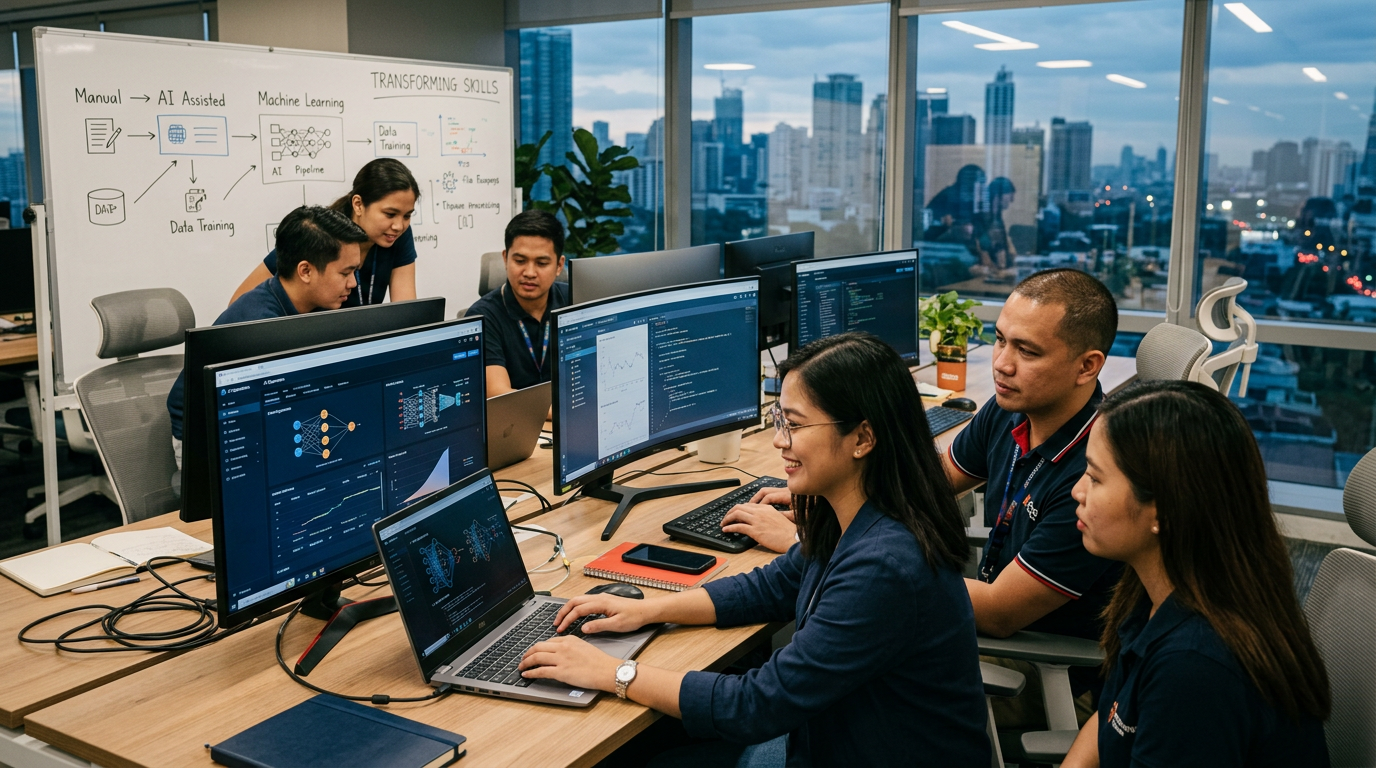
Rebuild Your Team for the New Labor Market
Experts warn that AI could displace more jobs than it creates in the Philippines, making retraining an urgent priority for anyone employing remote talent (The Philippine Star). If you have a virtual assistant doing data entry, you probably feel the pressure to figure out what happens next. The Philippine labor market is expected to change significantly, and you need a plan to keep your team useful (Philstar).
The mistake most business owners make is firing their current team to hire expensive specialists. The smarter move is to take the people who already know your business and bolt AI tools onto their existing workflows. You aren't replacing the human. You're upgrading the engine they use to do the work.
Retraining isn't a luxury. If you don't lead this transition, you'll lose your best people to companies that do. You can do this without getting bogged down in technical jargon by following a few specific steps.
Identify the Repetitive Bottlenecks
Start by looking at what your remote team does for 4 hours a day. If they're summarizing meetings, drafting emails, or sorting leads in a spreadsheet, those are the first things to automate. You want to move them from being the person who does the task to the person who manages the machine doing the task.
Think of this as moving from Doer to Editor. Instead of writing a 500 word blog post from scratch, your assistant uses a tool to generate a draft and then spends their time fact checking. They get more done in 30 minutes than they used to do in 3 hours. The quality stays high because a human is still steering the ship.
Build a Simple Training Stack
You don't need a complex curriculum. You need a clear goal, a specific tool, and a set of instructions. Pick one process this week, like customer support replies. Give your team access to a tool like ChatGPT or Claude and show them how to feed it your past successful emails as examples.
Remote workers are often scared that AI will take their jobs. You have to be clear that the goal is to make them more valuable. When they see they can handle double the workload with half the stress, they stop resisting and start innovating.
Standardize Your Prompts
A prompt is just a set of instructions you give to an AI: think of it like a recipe. If you want your team to be successful, you can't just tell them to use AI. You need to give them the exact recipes that work for your business. Create a shared document where you stack your best prompts for everyone to use.
This creates consistency. If one assistant leaves, the intelligence stays in your business because the prompts are documented. You're building a library of digital processes that your human employees operate. This is how you scale without adding massive overhead to your payroll.
Audit the Output Weekly
AI makes mistakes. It hallucinates, which means it confidently lies. Your team needs to know that their primary job now is quality control. Spend 15 minutes every Friday reviewing what the AI produced. If there are errors, don't just fix them: fix the prompt so the error doesn't happen again next week.
This loop is what builds a high performing remote team. You're sanding down the rough edges of the technology while your team gets faster. Eventually, your virtual assistant becomes an operations manager who uses AI to do the work of 5 people.
The First Step to Take Today
Pick one person on your team and one task they hate doing because it's tedious. Give them a paid account to an AI tool and tell them their goal this week is to cut the time spent on that task by 50% using the tool. That's it. Once they see it work once, they'll find 10 other ways to apply it.
If you want to see exactly how to wire these tools together, join our next 3 day training. I'll show you the specific prompts and workflows we use to keep overhead low and output high.
FAQ
What is the Philippine retraining model?
It is a tactical approach to upskilling offshore workers to handle higher value tasks using AI, responding to warnings that AI may displace traditional remote roles.
Will my remote team be resistant to using AI?
They might be if they fear job loss. You must frame it as a way to make them more valuable and efficient, not a way to replace them.
How do I start AI retraining for remote teams?
Identify one tedious, repetitive task and give your team a specific AI tool and prompt to reduce the time spent on that task by 50%.