Google DeepMind Solves the $100 Billion Weather Problem for Small Business
Google DeepMind's new WeatherNext AI model predicts cyclones and extreme weather more accurately than traditional supercomputers. This allows small businesses in logistics and outdoor services to plan schedules and supply chains with certainty, reducing wasted labor and lost revenue.
Key Takeaways
- WeatherNext uses historical data patterns rather than complex physics equations to predict storms.
- The AI model outperforms the global standard (ECMWF) in tracking cyclone paths and intensity.
- Small businesses can use this data to reroute supply chains and manage labor costs proactively.
- Proactive planning based on AI data can lead to lower insurance risks and fewer operational losses.
- Hyper local nowcasting will soon provide 2 hour windows of weather accuracy for site work.
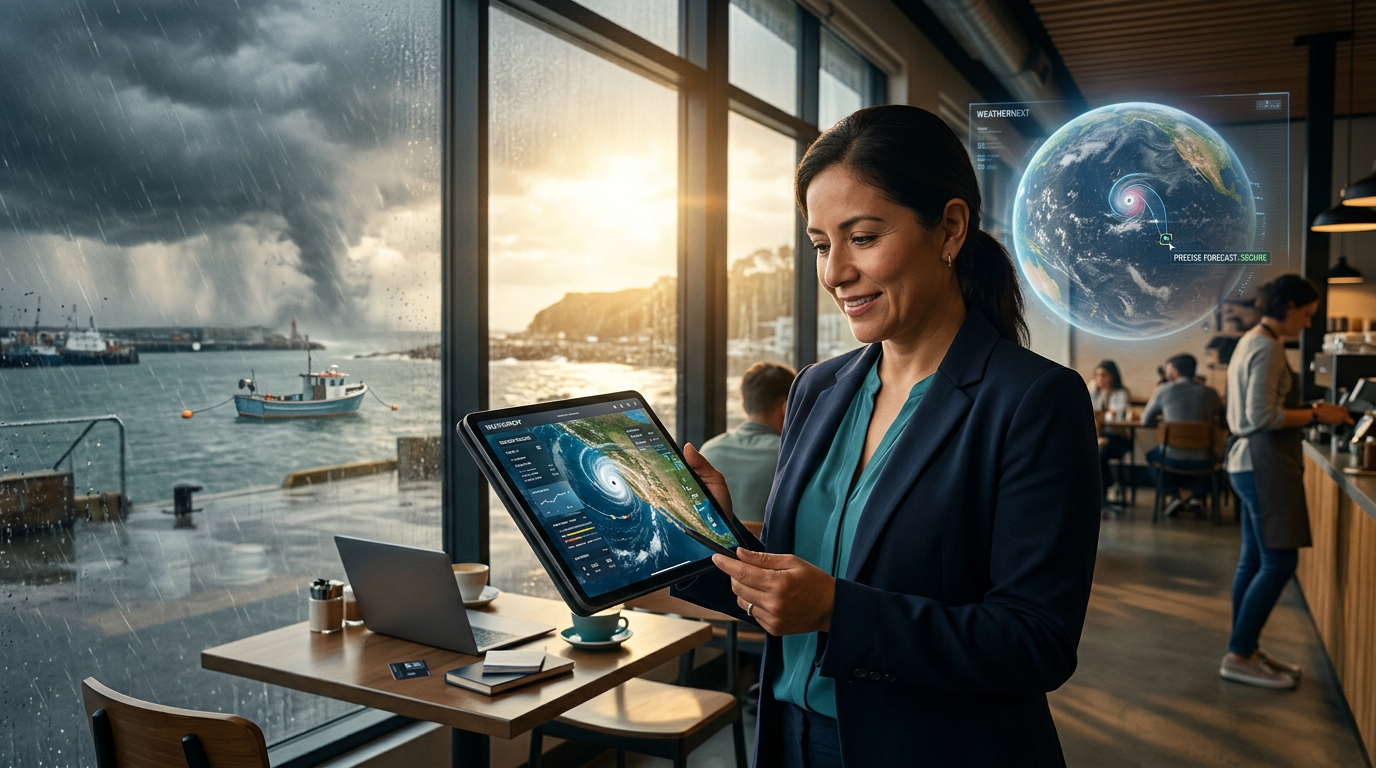
The End of the Guesswork Era
Google DeepMind just announced a technical shift that changes how you plan your business week. Their new model, WeatherNext, is now beating traditional systems at predicting the most dangerous weather events on earth. According to the official DeepMind report, this AI model tracks tropical cyclones and extreme weather better than the systems we have used for decades.
If you run a logistics company, a landscaping crew, or an outdoor event space, this matters. For years, small businesses have been stuck with 50/50 guesses from local news apps that rely on slow, expensive physics simulations. DeepMind is replacing those math equations with AI that learns from past patterns. We are moving from regional forecasts to predictions that hold up when you are deciding whether to send a fleet of trucks out or cancel a $10,000 outdoor wedding.
How WeatherNext Flips the Script
Traditional weather forecasting uses supercomputers to solve massive physics equations. It is slow, takes huge amounts of power, and often misses the specific path of a storm by 50 miles. WeatherNext uses a different approach. It analyzes 40 years of historical weather data to find patterns that the old math misses. The results are startling. The DeepMind data shows that this AI model predicts the intensity and path of tropical cyclones with higher precision than the European Centre for Medium-Range Weather Forecasts (ECMWF) model.
When the forecast is wrong, you lose money. You pay for labor that stands around in the rain, or you miss out on revenue because you closed shop for a storm that never arrived. This technology strips back the uncertainty. It is not just about knowing it will rain; it is about knowing exactly where the wind will hit and when the surge will start. This is AI weather forecasting for business that impacts the bottom line.
Why Small Business Owners Should Care Today
This technology will be bolted onto every shipping app and scheduling tool you use within the next 12 to 18 months. When big players like Google solve a forecasting problem, the data trickles down to the apps on your phone. You will soon have access to professional grade risk assessment that used to cost thousands of dollars a month for free.
Think about your supply chain. If you know a week in advance that a specific port or highway will be hit by a cyclone with 90% certainty, you can reroute shipments before prices spike. If you are in the service industry, you can stack your schedule on the clear days and pause operations on the dangerous ones without the usual anxiety. We are talking about saving tens of thousands of dollars in wasted overhead every year.
The Practitioner View: Most business owners treat the weather like an act of God they can't control. Start treating it like a data point you can optimize. If you aren't looking at how AI driven forecasts can lower your insurance premiums or fuel costs, you are leaving money on the table. The tech is here: you just need to wire it up to your decision making process.
4 Steps to Integrate AI Forecasting This Week
You do not need to be a data scientist to start using this. You just need to change where you look for information and how you act on it. Here is how to get ahead before the next storm season hits.
- Audit your weather sources. Stop relying solely on the local news or the basic app that came on your phone. Start looking for tools that mention machine learning (AI that improves itself through data) or AI based forecasting. Many are already pulling data from the models DeepMind is perfecting.
- Create a Weather Trigger document. Write down exactly what you will do if a storm has a 70% probability of hitting your area. Do not wait for the morning of the storm to decide. If the AI says it is coming, trust the data and execute the plan you built when you were calm.
- Verify your insurance coverage. With better forecasting comes higher expectations from insurers. Talk to your agent about whether your policy covers proactive measures taken based on advanced warnings. Moving equipment early can sometimes save you from a denied claim later.
- Watch the Google Earth Engine. Google often releases these tools to the public via their Earth Engine platform. Keep an eye on how these cyclone models are being visualized. Seeing a heat map of projected wind speeds can help you decide which job sites to secure first.
What to Watch Next
The next big shift will be nowcasting. This is the ability for AI to tell you what the weather will do in the next 2 hours with nearly 100% accuracy. DeepMind is already working on this. For a logistics business, that means knowing exactly when a 30 minute window of clear skies will open up to unload a truck. For a contractor, it means knowing you have exactly 90 minutes to finish a roof before the first drop hits.
The tech is moving fast, but the goal is simple: stop guessing. The businesses that thrive in the next five years will be the ones that use these tools to remove the maybe from their operations. If you want to see exactly how to wire these kinds of AI tools into your daily workflow, join the next 3 day training where we walk through the setup step by step.
FAQ
Is AI weather forecasting really better than the local news?
Yes, because traditional news often relies on physics models that are slow to update. AI models like WeatherNext analyze decades of patterns to provide more precise path and intensity predictions for major storms.
How can a small business access this DeepMind technology?
The data is being integrated into commercial weather apps and Google's own tools. Look for apps that specify they use machine learning for their forecasts.
Will this help me if I don't live in a hurricane zone?
Absolutely. While the breakthrough focused on cyclones, the underlying technology improves forecasting for all extreme weather, including sudden heavy rain and wind shifts that affect daily outdoor work.